
20 years of Six Steps: Strengthening workforce planning across healthcare
For 20 years, Six Steps has supported organisations across health and care to plan their workforce more effectively. Developed in response to the growing complexity of workforce challenges, Six Steps began as a practical methodology designed to bring structure and consistency to workforce planning.
Over time, it has evolved into a comprehensive managed service and training programme, supporting organisations to move beyond isolated planning exercises and embed workforce planning as a core organisational capability.
Building workforce capability at scale
At the heart of Six Steps is a focus on building workforce planning capability that can be applied consistently across organisations and systems. Through structured training and expert support, Six Steps has helped thousands of workforce planners, managers, and leaders develop the confidence and skills needed to make informed workforce decisions.
Over two decades, this has translated into measurable impact:
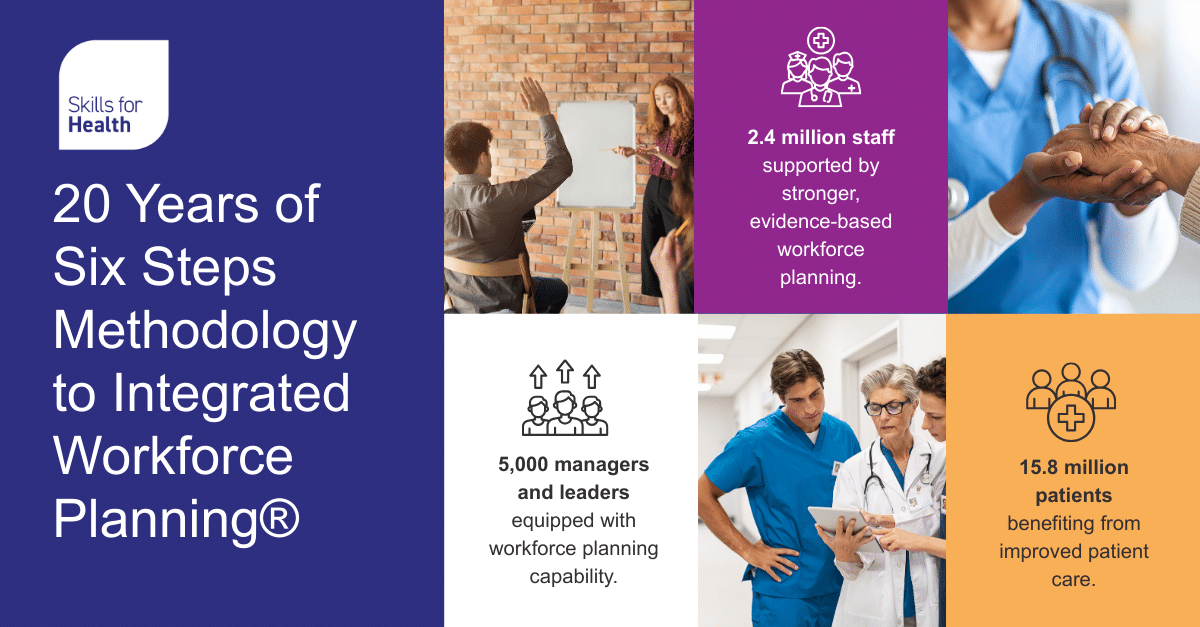
- 5,000 managers and leaders equipped with workforce planning capability
- 2.4 million staff supported through improved workforce planning
- 15.8 million patients benefiting from safer, more reliable care
The programme has delivered a strong uplift in confidence, with self-assessed confidence scores increasing 39% from 2.95 to 4.1 (averaged across a range of skills indicators.) This level of shift is significant: workforce planning requires proactive leadership and confident decision-making. By moving participants into high-confidence territory, the programme strengthens organisational capability to anticipate workforce needs, implement change more effectively, and align staffing models to service demand, supporting workforce stability and more sustainable, reliable services for patients.
A trusted and recognised approach
Six Steps has become widely adopted across healthcare, supporting organisations to align workforce supply with service demand and long-term strategy. Its use spans trusts, integrated care systems, primary care, and community settings, reflecting its flexibility and relevance across different organisational and system contexts.
- Berkshire West Integrated Care Partnership used Six Steps to support system-level workforce planning, bringing partners together around a shared framework and strengthening confidence in workforce plans across services.
- At Oxford University Hospitals NHS Foundation Trust, Six Steps supported the development of an integrated workforce plan that linked service priorities with workforce numbers and skills, helping align workforce planning with long-term organisational goals.
- In North Devon, Six Steps was used across multiple Primary Care Networks to support local workforce planning, enabling teams to tailor their approach to population needs while building planning capability across the system.
“Skills for Health’s Six Step Methodology was selected due to its accessibility and credibility within health and social care. Embedding the model has enabled us to identify priority areas as an Integrated Care Partnership which will feed into the wider BOB ICS ‘People’s Plan’ workforce strategy.”
– NHS Berkshire West CCG
“What you’ve left us with is a group of PCNs who are in a better place to start thinking about what an integrated workforce plan might look like. It left us with the ability to adapt our workforce plans iteratively and the approach ensures we can adapt our workforce assumptions to make it futureproof.”
– NHS South East London Integrated Care Board
What’s next for Six Steps
The next phase of Six Steps focuses on widening access and strengthening workforce planning practice across organisations.
- A new open programme will widen access to workforce planning skills, particularly for operational teams, ensuring workforce planning is not confined to strategic roles alone.
- A resilience programme will support organisations to stress-test workforce plans, explore scenarios, and strengthen preparedness for future pressures.
These new developments sit alongside existing routes to engagement, including in-house training and managed service support, giving organisations flexible options to build workforce planning capability in ways that best meet their needs.
As Six Steps marks its 20-year milestone, the focus remains on supporting organisations to plan their workforce effectively, sustainably, and with confidence, strengthening services for staff and patients.
Find out more about our impact
Learn more about The Workforce Development Trust.